

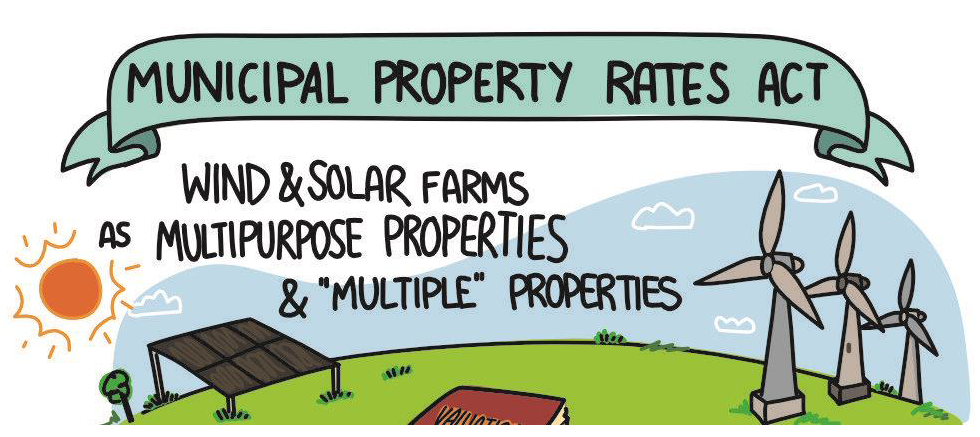
 How the Municipal Property Rates Act treats South Africa’s wind and solar farms
Wind and solar farms as multipurpose properties — entries in the valuation roll require both valuation and apportionment between freehold and leasehold.
South Africa’s shift toward renewable energy has quietly created one of the more interesting valuation and rating puzzles under the Municipal Property Rates Act 6 of 2004 (“MPRA”): how should a municipality rate a farm that hosts both agriculture and a multi-million-rand wind or solar installation? The answer turns out to hinge on two related but distinct ideas — multiple-use properties and “multiple” properties — and on how a rates valuer apportions value between them.
1. Wind and Solar Farms in South Africa
Renewable energy generation has grown rapidly in South Africa since the launch of the Renewable Energy Independent Power Producer Procurement Programme (REIPPPP) in 2011. The programme invites private Independent Power Producers (IPPs) to develop, finance, build, operate and maintain wind, solar, biomass and small hydro projects under contracts typically spanning 20 to 30 years, with the electricity generated sold to Eskom.
Wind farms
The South African Wind Energy Association (SAWEA) notes that the country has world-class wind resources, particularly along its roughly 3 000 km coastline. By 2026, South Africa had around 60 wind farms, of which 11 are still under construction.
Independent Power Producers own all but one of these facilities — the only Eskom-owned wind farm is the Sere Wind Farm near Vredendal in the Western Cape, contributing roughly 105 MW.
A wind farm consists of numerous turbines, each with three large blades turned by the wind. The blades drive a shaft connected to an electric generator inside the nacelle housing (which also contains the gearbox and transformer). Blades can be up to 90 m long, turbine towers up to 120 m tall, and a nacelle can weigh between 80 and 120 tons.
Wind farms typically operate at an average efficiency of only 30–45% of nameplate capacity, though output can spike well above this — the highest contribution recorded during 2023 was 3 102.2 MW, around 90% of total installed capacity.
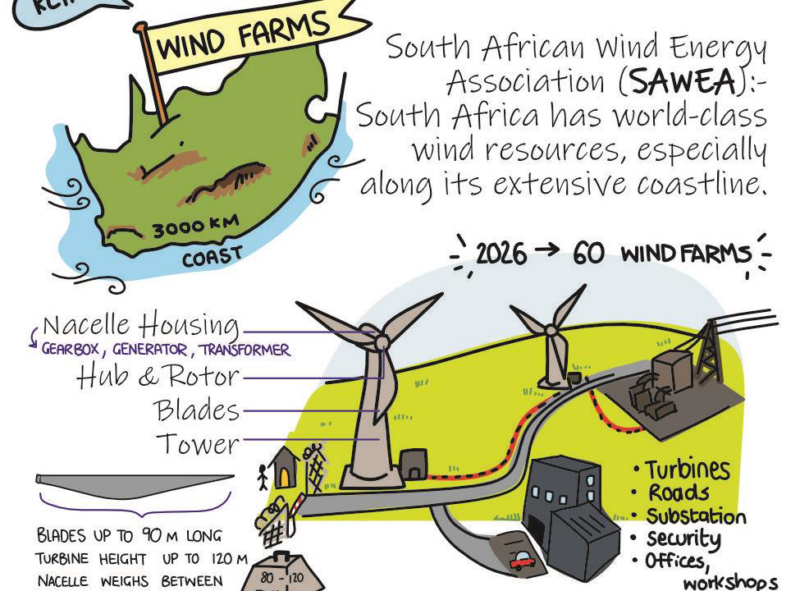
Anatomy of a wind farm: nacelle housing, hub and rotor, blades and tower, plus the supporting roads, substation,
security and offices on site.
Solar farms
As of May 2026, there were 56 solar farms in South Africa. Smaller sites cover around 19 hectares, while larger plants require between 200 ha and 800 ha. Most South African solar farms use photovoltaic (PV) panels mounted on fixed or rotatable frames, though there are also several concentrated solar plants (CSPs) with a combined capacity of roughly 500 MW.
The Kenhart Solar Farm illustrates the scale involved: 1 million panels, 456 battery storage units (each the size of a shipping container and weighing 30 tons), spread across 879 ha stretching 10 km from north to south.
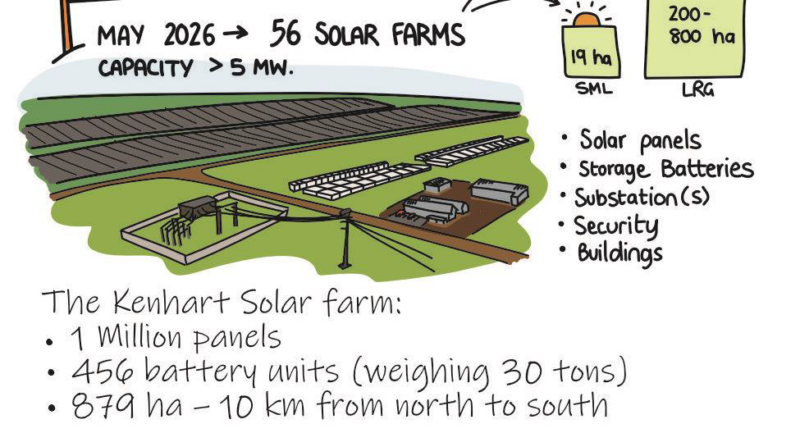
A solar farm’s footprint includes panels, storage batteries, substations, security infrastructure and buildings — not just the panel field itself.
2. Registered Leases
Because of the massive capital investment required, wind and solar farms are almost always developed on leased land, with developers securing their interests through a registered long-term lease. Understanding the lease terms matters for rating purposes because it explains how the “development area” relates to the much larger “lease area”.
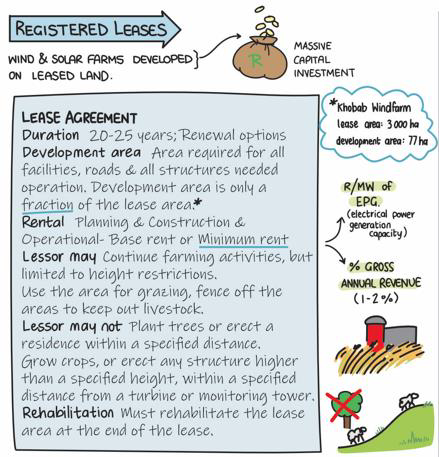 Typical lease agreement terms for a wind or solar farm.
(For scale: the Khobab Windfarm’s lease area in the Hantam Municipality is about 3 000 ha, while its development area is only 77 ha.)
3. Multiple-Use Properties and “Multiple” Properties
Wind and solar farms are both multiple-use properties and “multiple” properties — two different concepts that are easy to conflate.
- Multiple use is the obvious part: farming and electricity generation both take place on the same property.
- “Multiple” properties is less obvious. It requires an understanding of the MPRA’s definition of “property.” A wind or solar farm typically comprises both a freehold component (the farm itself) and a leasehold component (the registered lease held by the operator of the wind farm) — and under the MPRA these are treated as separate properties, each requiring its own valuation roll entry.
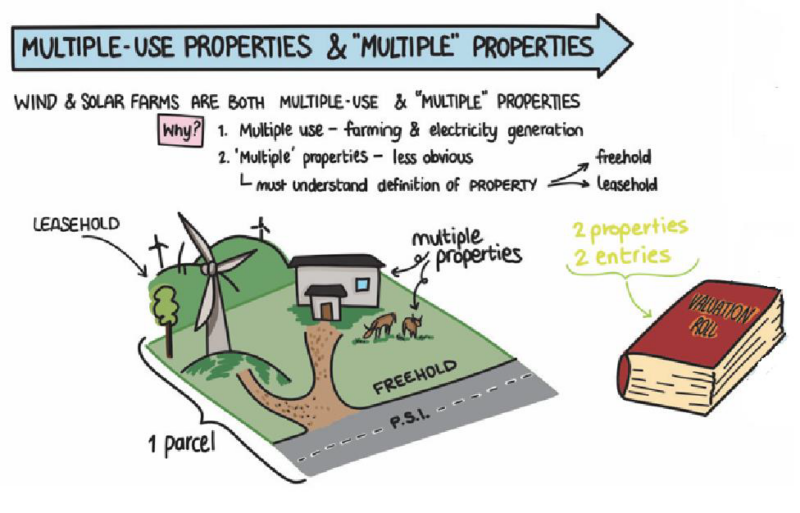 One parcel of land can contain two “properties” for rating purposes — the freehold and the registered leasehold — meaning two valuation roll entries.
Definitions that matter
- Property:
- (a) immovable property registered in the name of a person; or
- (b) a right registered against immovable property in the name of a person (excluding a mortgage bond).
- Owner: in relation to (a), the person in whose name ownership is registered; in relation to (b), the person in whose name the right is registered.
- Category: a category of properties determined under section 8, or a category of owners determined under section 15(2).
- Multiple purposes: the use of a property for more than one purpose, subject to section 9.
4. Rates Policy — Sections 3–6
Every municipality must have a rates policy, reviewed annually as part of the budget process. Among other things, its purpose is to:
- Determine categories of properties for differential rating (i.e. different rates tariffs); and
- Provide relief measures such as exemptions, rebates and reductions.
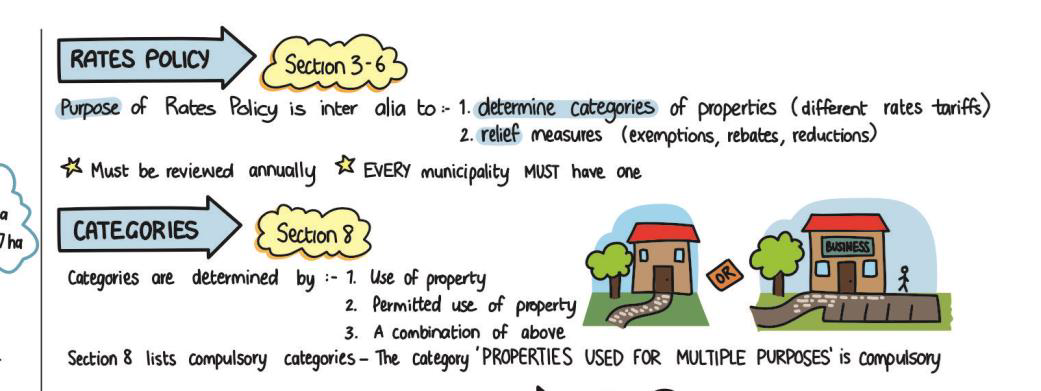 The rates policy determines categories of property (section 8), and the category “properties used for multiple purposes” is compulsory.
Categories — Section 8
Categories are determined according to the use of the property, its permitted use, or a combination of both. Section 8 lists compulsory categories where they exist in a municipality, and the category “properties used for multiple purposes” is one of them — directly relevant to wind and solar farms.
5. Properties Used for Multiple Purposes — Section 9
Section 9 sets out three possible bases for categorising a property used for more than one purpose: permitted use, dominant use, or multiple purposes.
- Permitted use refers to what the property may be used for under the zoning in the town planning scheme.
- Dominant use is not defined in the MPRA and is therefore open to interpretation where the rates policy is silent.
- Multiple Purposes Because “properties used for multiple purposes” is a compulsory category, permitted use and dominant use are no longer available as options — section 9(2) becomes applicable.
It requires the rate to be determined by:
- (a) apportioning the market value of the property, in a prescribed manner, to the different purposes for which it is used; and
- (b) applying the rates applicable to the relevant categories to those different market value apportionments.
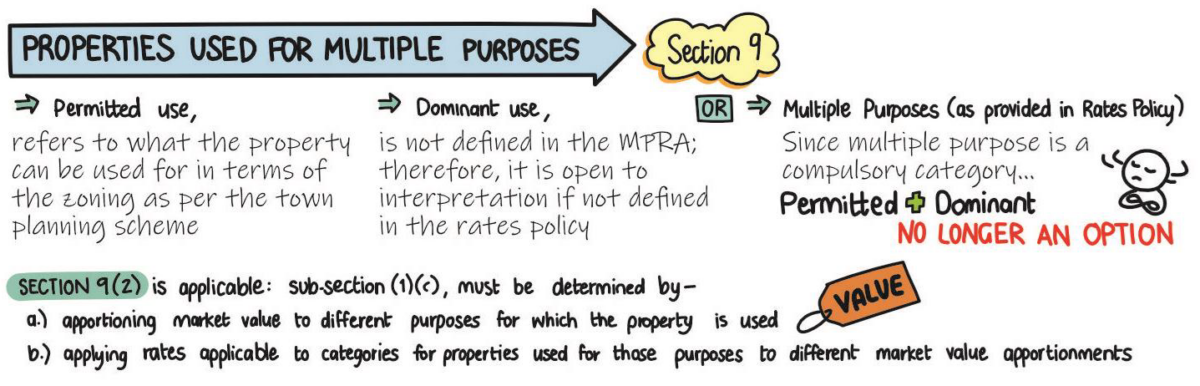 Section 9 in a nutshell: with permitted and dominant use no longer an option, apportionment under section 9(2) must split market value across the property’s different uses.
The manner of apportionment has never been prescribed, and the MPRA gives no direction on how it should be done — a gap that has caused numerous disputes, not helped by rates policies that are often vague on the point.
The “Connaught” case
This issue was argued before the Johannesburg Valuation Appeal Board and later reviewed by the High Court and the Supreme Court of Appeal in what is known as the “Connaught” case (City of Johannesburg v Chairman Valuation Appeal Board and Another). At the appeal hearing it was argued that value could be apportioned in one of two ways:
- According to building size; or
- According to the income of the subject property.
Both the appellant and the municipal valuer agreed that the building-size method was most appropriate in that instance, because the property was a typical mixed building with income-generating shops on the ground floor and residential apartments above, and the components were not valued separately — income was capitalised and then apportioned according to the extent of each use. Neither the High Court nor the Supreme Court of Appeal ruled on the apportionment method, since that was not the matter under appeal.
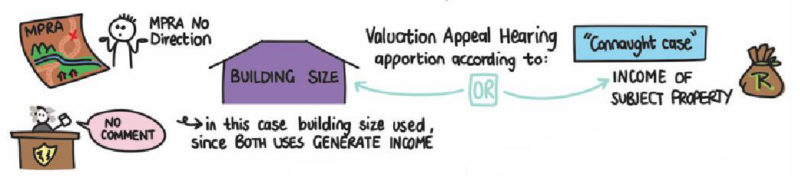
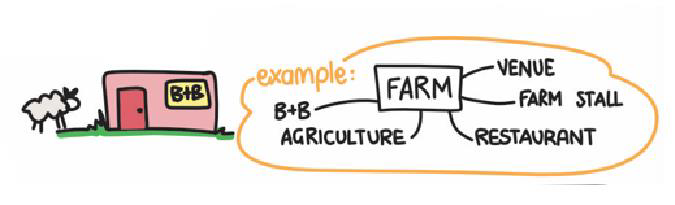
Following that logic, apportioning by income is likely to be more appropriate where the valuation approach differs between the components — for example, an agricultural property that also hosts a business component such as a restaurant, conference venue or farm stall, where each component is valued using a different method.
In Charlewood N.O. and Others v Valuation Appeal Board for the Nelson Mandela Bay Metropolitan Municipality and Others (ECP, 12 December 2017), the High Court held that farms used for both farming and commercial purposes (such as a restaurant and farm stall) ought to be categorised as multi-purpose properties according to their actual and permitted use — they are “no longer purely agricultural use properties.” The Court also held that once such businesses commence on a farm, the farm is no longer run purely as an agricultural entity, but as a property generating income from more than one source.
This reasoning applies directly to wind and solar farms: agricultural land hosting a wind or solar installation, generating substantial income from electricity sales, is no longer purely agricultural — it must be recognised, valued and rated as a multi-purpose property, apportioned between its farming and its energy-generation uses.
6. The Valuation Roll — Section 48
Section 48 requires the valuation roll to reflect the following particulars for each property, as at the date of valuation, to the extent reasonably determinable:
- The registered or other description of the property;
- The category determined in terms of section 8;
- The physical address of the property;
- The extent of the property;
- The market value of the property, if valued;
- The name of the owner; and
- Any other prescribed particulars.
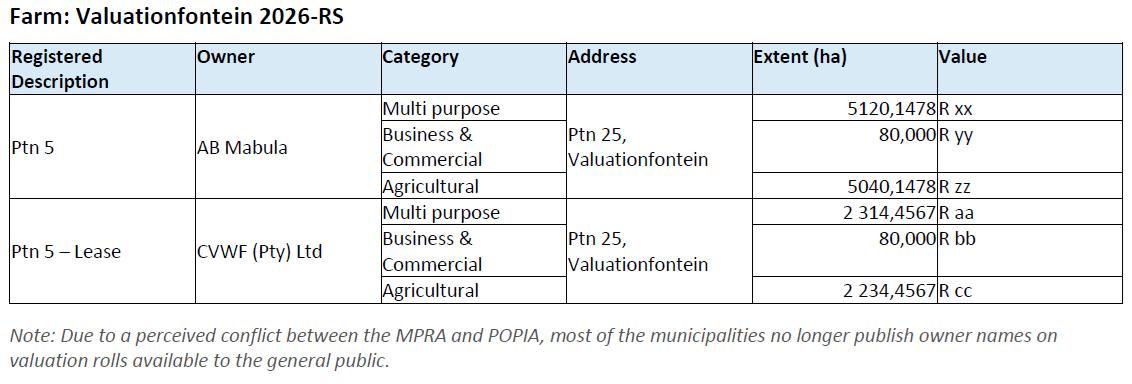
Applied to a wind or solar farm, this means the freehold and the registered leasehold are reflected as two separate entries — each apportioned across its multi-purpose categories. A simplified example for a fictional farm illustrates this:
Putting it together: an example
A single farm might generate rateable income from several sources at once — agriculture, a bed-and-breakfast, a farm stall, a function venue or restaurant, and now a wind or solar installation. Each of these uses may need to be identified, valued and apportioned separately under section 9(2), and where the farm is subject to a registered lease for the renewable energy component, that leasehold interest becomes its own “property” with its own valuation roll entry.
Conclusion
Wind and solar farms sit at the intersection of two rating concepts that are often confused: multiple use (farming and electricity generation happening on the same land) and “multiple” properties (the freehold and the registered leasehold being separate properties under the MPRA). Because “properties used for multiple purposes” is a compulsory rating category, municipalities must apportion market value across these different uses under section 9(2) — yet the MPRA provides no prescribed method for doing so. Until such guidance is issued, valuers and municipalities will need to reason from case law such as Connaught and Charlewood, choosing between building-size and income-based apportionment depending on which best reflects how value is actually generated on the property.
The article is based on a presentation by Ben Espach at the SAIV’s Central Branch Agricultural Seminar, 3 September 2026, Bloemfontein.
Illustrations: Maggie Ackerman, maggie@littlejuliet.com